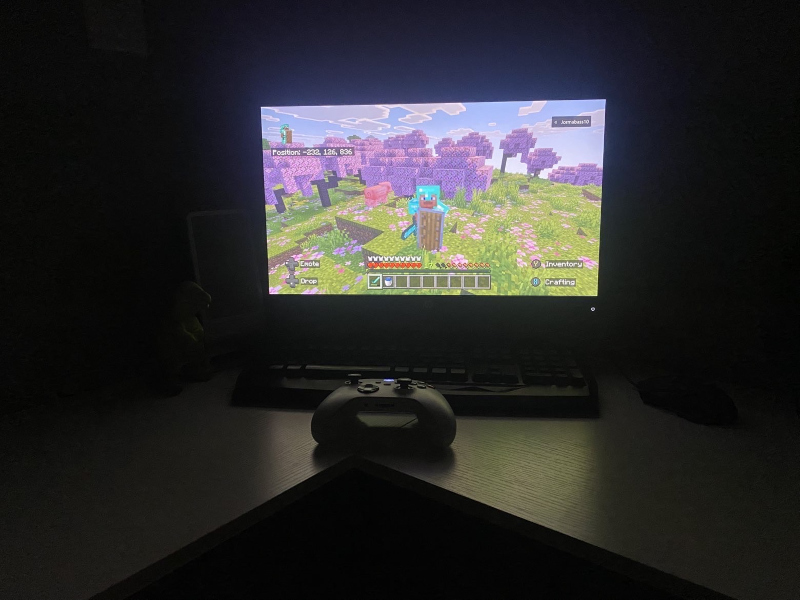
By Mac Durham
Video games have been popular with the youth since the 1970s. Due to this, school and video games often clash or correlate with one another. This leads to the question, do video games affect students? The answer is complicated.
According to the Pew Research Center, “85% of US teens say they play video games, and about four-in-ten do so daily” making teens that do game a majority by a large margin.
It seems to be common knowledge by now that most students play video games, but why is this?
“Our youth have grown up looking at screens,” English teacher Ms. Amanda Craw said. “So that’s just what they know and what they’re familiar with. I’m not saying that that’s necessarily a bad thing, but it is a comfort thing for them to continue to want to play games. You’re in a place that’s comfortable for you. You don’t have to leave.”
Ms. Craw also believes that the accessibility of mobile games have made addiction much more prevalent, especially with the younger, less developed minds of teenagers.
Gym and health teacher Mr. Jacob VanPelt has a more personal view on video games, commonly playing them himself.
“I think it’s a way for them to plug in,” he said. “I think it’s fun because you’re experiencing things while not being out there. I think part of it is using your imagination in life. Like the NFL football game — you can make yourself a coach.”
Mr. VanPelt believes that video games can help stimulate creativity by allowing players to do things that would otherwise be impossible.
It seems students play video games for an array of reasons, but what about the elephant in the room?
Claims of video game induced violence have been a topic for news outlets and concerned parents since the ’70s, but hold little evidence.
While sharing the closing remarks of a study about video games and their correlation to violence, a study of 1,000 British teenagers published in Royal Society Open Science concluded, “The results provide confirmatory evidence that violent video game engagement, on balance, is not associated with observable variability in adolescents’ aggressive behaviour.”
To summarize, the intensive studies they conducted led to the conclusion that video games have little to no effect on teen violence.
Violence may not be a concern, but what about other potential effects video games could cause?
Academic performance may come to mind while pondering the question, and it can definitely be the case for some.
Sophomore Emmett Hay is an avid gamer, regularly playing games about fishing. Hay said that he is almost always gaming if he is at home.
“I think my grades would definitely be better if I studied instead of playing video games,” Hay said.
It could be easy to take this information and assume that playing video games will undeniably result in lower grades, but let’s take a deeper look into the matter.

Sophomore Breighlyn Ellis is yet another avid gamer, commonly playing Fortnite or Rocket League with his friends after a long day of school.
“Honestly, I don’t think they really impact my grades all that much,” Ellis said. “I still get my homework done and study for my tests, so I don’t really feel it interferes with school at all.”
These two students seem to contradict one another, so responses from less biased individuals may give more insight.
“I would say they might hurt grades,” said Mrs. Mindy Crawmer, the teacher of Delta’s Certified Clinical Medical Assistant program. “Kids are so focused on their game that they tend to do that longer and not get their school work done in the evening and different things like that.”
Mrs. Crawmer brings up a lack of self control that is most likely doing the most damage to students, and this idea is something that seems to be agreed upon by most teachers.
Mr. VanPelt believes that time management is the determining factor in the outcome video games have on students, not the video game material itself.
“You have all these things that are pulling your time away, and video games are one,” VanPelt said. “If you can balance and have the time management for all those different things, then I don’t think it’s going to affect you. It’s just, if you string yourself so thin with all these different things you want to do, and then you never have time to ever relax or to get all of the stuff done that you want to get done, I think that’s a problem.”
Ms. Craw has a similar outlook on games, suggesting possible positives video games can present.
“I don’t really think they affect grades unless it’s becoming an obsession,” Ms. Craw said. “I don’t necessarily think that it helps, but I don’t think that grades are the be-all end-all of what makes a person. And I think that there are other benefits if it’s used in moderation.”
Students with self control and time management may actually benefit from playing video games, but how?
Spanish teacher Mrs. Shawn Churchill suggests that video games can be a way for students to socialize and connect with one another when used correctly, along with being a viable study tool.
“Sometimes I’ll do Gimkit or Quizlet and those are kind of game-based,” Mrs. Churchill said. “In class, some say that’s the only way you can get them to learn that will stick in their head.”
It seems that moderation can make or break a student’s relationship with video games, so how can students effectively balance games with everything else occurring in their life?
Mrs. Churchill recommends regularly going outside to get some vitamin D, along with setting time limits.
Mr. VanPelt stresses that video games should not be students’ top priority.
“Make time to exercise, try to eat healthy and burn your calories,” VanPelt said. “I’d say still have time to get your homework done and still have a social life that’s not just, ‘Hey, I’m on a headset talking to somebody.’”
Maybe the question should not be if video games affect students, but rather how can students have a healthy relationship with them. Responsible or not, the choice is yours.