By Riley Holtzclaw
Editor’s Note: At the time of writing this article, the bill has been passed by the Senate and House of Representatives. Governor Mike Braun signed the bill into law on March 5. It will be implemented in July 2026 for the 2026-2027 school year.
Cell phones and schools have been against each other for almost three decades. With the constant clashing between calls and calculus, schools have had an uphill battle when it comes to monitoring cell phone usage by students. But a bill that zipped through the Indiana Legislature will try to end this decades long war.
The name is Senate Bill 78. Its purpose is to prohibit students from using wireless communication devices during school hours. According to the Indiana General Assembly, it considers a wireless communication device as “a cellular telephone, a tablet computer, a laptop computer, a gaming device, or a smartwatch that is connected to a cellular telephone, a cell tower, or the Internet.”
Seems pretty cut and dry, right? Well, not really. You see, a simple statewide ban will do little in terms of helping kids. Remember earlier when it was the 2024-2025 school year, and teachers and lawmakers were making a big deal about Senate Bill 185. Does that ring a bell?
Senate Bill 185 was essentially the grandpa for Senate Bill 78. Both bills aim to limit students’ access to cellphones during the school day. SB 185 was much more lenient and is what we currently follow here at Delta. It stated that students could not have access to cell phones during instructional time, meaning essentially whenever the teacher is actively teaching or during a test. You can still have your phone out during lunch, during passing periods, and whenever the teacher permits it.
Principal Joey Gossett stated that under this bill, things went smoothly.
“We’ve had maybe three or four students get the third cell phone related referral, but we handle them individually. We communicate with the parents,” she said. “But that’s three out of, like, 800.”
Senate Bill 78 is a much bigger step up from that bill. But a stricter cell phone ban isn’t the correct call. It may seem like it at first. Ensuring that students can’t have their phone with them should help stop distractions and keep students focused. Well … there are some issues that various lawmakers and advocates for this bill haven’t really acknowledged.
Firstly, it is stated that a student CAN have a cell phone or “wireless communication device” IF they have the following conditions, according to the bill:
- If the device is provided by the school for the class.
- If the device is to help with disabilities (according to the Federal Rehabilitation Act of 1973).
- If the device is needed for medical purposes.
- If the superintendent authorizes their use during an emergency.
- If the device is being used for translation.
But there’s something missing within that list. What about the classes that benefit academically from the use of a cell phone? For example, in Tim Cleland’s journalism classes, cell phones are used every day for filming Eagle Zone News, recording transcripts of newspaper and yearbook interviews, relaying messages, and taking photos. Removing cell phones would be an active detriment toward those classes.
Cleland said the new rules will make things more difficult.
“You’d have to go back to writing (interview notes) with pen and paper, and that was extremely hard for a professional journalist like myself to do, so (it will be hard) for a student who is just starting to be able to write down the key points of what they say and keep up with it.” He said his concern is having “less accurate stories” after the new law takes effect.
Cleland has also stated that the three journalism cameras his classes currently use each cost $800 or more. If every routine head and shoulders photo now must be taken by one of the classroom cameras instead of on cell phones, the 25 Eagles’ Eye reporters and 40-50 yearbook students will have to share limited resources. Some students have never used an actual camera before, so they will have to take time to practice using the cameras. He also stated that with many more students handling the cameras, the risk increases that they will be broken, and they are expensive to fix or replace.
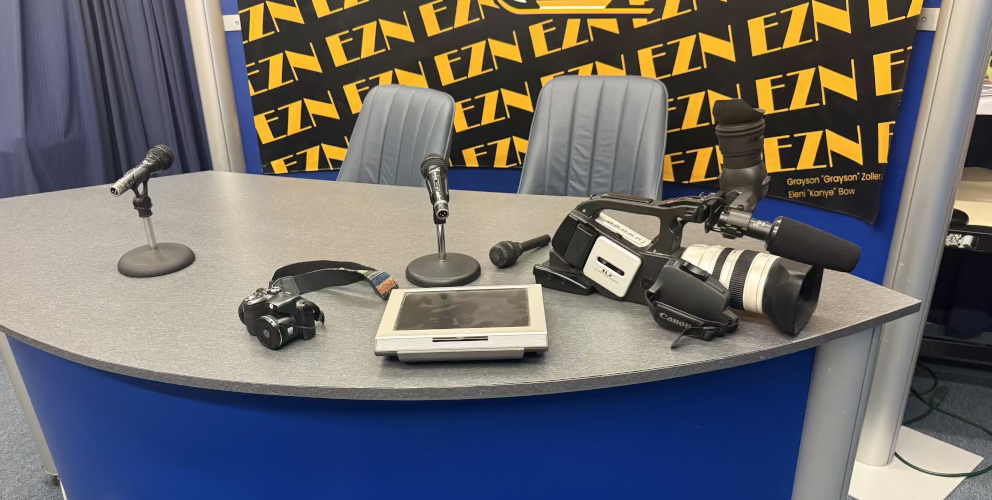
Eagle Zone News wouldn’t be safe either. While there is some recording equipment within the studio, much of it is decades old and/or broken. The outlets that the microphones, spotlights, and camera plug into are inaccessible and decades old as well; not only meaning they most likely wouldn’t work, but would also be a fire hazard if they were being used constantly after not being touched in a while. Also, the computers might need to be replaced so that the video camera could plug into the computer or transfer the videos via an SD Card which is a more outdated system than the much quicker system of air-dropping files from a phone.
Now the bill does state that school-provided cell phones are allowed, but this would be extremely costly and the possibility of having to buy or repair the phones multiple times would probably turn off school administrators.
Additionally, Delta High School offers dual credit courses for Ball State University and Ivy Tech. However, to sign up for some of these classes, you must use the Duo mobile app, to scan a QR code or input a security code to access your account. If cellphones are barred from school, students will need another way to sign into their college classes.

Gossett further added to this point, stating ,”As an adult when I was doing my doctorate, I had to use that app on my phone.” She continued, “How are students going to access and do Ball State courses? Is Ball State going to help us with that?”
Essentially, if the bill that is supposed to help with education is actively being a detriment, is the bill even worth implementing?
Secondly, there is always the case of an emergency happening. It’s a sad but warranted reason. Cell phones can be the difference between life and death during an emergency.
Yes, teachers would still have their phones with this bill implemented, but students may want to contact their loved ones or inform the authorities on what is going on.
Now some might argue that a security issue like this could be resolved by installing metal detectors or other security devices to alert the school on where the threat or incident may be, which would be great… if they weren’t so expensive.
You see, most metal detectors go for $2000-$4000. Some even upwards of over $10,000. How are we going to be able to pay for all of that? Well, with taxes and other fees.
This is also similar to the whole cell phone debacle. Some schools nationwide have implemented devices known as Yondr pouches, which are essentially a fabric bag with a magnetic lock on it that can only be removed by administrators at the end of the day. These pouches cost around $25-$30 a pouch. Delta has over 800 students. That equals to around $20,000-$24,000 in total. Hopefully people love Wick’s pies, because the fundraisers would be relentless if the school had to pay for this.
That’s right. The school will have to provide its own funding for the security measures to prevent students from accessing their phones. Now this wouldn’t be so bad if 50.9% of Hoosier students weren’t in inadequate school districts because of a lack of funding, according to the Schools Finance Indicators Database. How are the schools that have low finances supposed to buy expensive storage equipment for cell phones?
So if pouches are too expensive, why not simply store them in the student lockers? The bill does state that the locker is considered a “secure place” for the phone.
But let’s be honest here, students would most likely ask to use the bathroom, go to their locker, go to the library, and go to the nurse multiple times within the day, just to walk to their locker and check their messages and notifications. Which could lead to the bathroom rules that a few students say are already pretty strict to become even worse.
So it seems like this is a lose-lose scenario. You either spend tens of thousands of dollars on security devices to keep the phone inaccessible for the student, or you save money but have to constantly battle against students going to their locker and getting their phone.
Now not everyone here at Delta thinks that this bill is a bad thing. English teacher Mrs. Betsy Gilmore felt like the bill “will really help students be more invested in their time at school.” And she does have some merit to that claim. Students should be socializing more and focusing more on their studies than on social media.
However, this bill just is not the best way to alleviate the issue. It limits the students’ freedom to make their own choices. And banning phones completely, even during passing periods and lunch, just seems like overreach.
So what are we supposed to do? Obviously students shouldn’t be on their phone when teachers are teaching, but this ban seems to be taking things too far. For starters, students should be able to handle not being on their phone, especially in high school. And here at Delta, the students have been able to control themselves. Gossett stated, “You guys, for the most part, have been pretty good about not having them out in class unless a teacher instructs you to do so.”
Gossett added: ”I think it’s important that there is some kind of rule, but to say they’re going to ban them altogether is a bit harsh. I think I can see both sides of the story, so it’s difficult for me.”
So what can we do now? The bill is already signed and passed into law. If you are opposed to the bill, you can contact your state representatives and tell them how you feel about the bill. Senators and representatives are supposed to work for us, so if enough people have an issue with the law, it possibly could be amended in future congressional action. And if they do not listen to the people, we can vote them out of office. They work for us, not the other way around.
Now Delta, as a school, should try to make an announcement to parents and students before the law is enacted. Gossett stated that the administration will try to get the word out “to let them know that we made changes to apply to the new law.“ What these changes will entail is still unknown. What would the punishment be? What changes will be made?
As of right now, just keep following the current law, but also voice your frustrations and opinions. And then let the state politicians know how you feel during the next election cycle.
This article is the opinion of senior Riley Holtzclaw. It is not necessarily the opinion of Eagle’s Eye newspaper or Delta High School.