By Tyce Dishman
The device buzzed in the quiet as he stepped forward carefully in a heavy hazmat suit. Thick gloves clenched to the handle of a radiation detecting device.
Bright red hazard tape fluttered in the wind. Somewhere beneath the dirt and debris, a pocket of radioactive waste must be found and contained. He paused carefully before signaling to the rest of the team to come over.
For him this isn’t just another mission, this is the work of which he dreams. Maddox Patterson is one of a few Delta High School seniors who plan to enlist into the military after high school.
Patterson plans to enter one of the most dangerous programs in the military. Scenes such as the one described above could be in his future.
The Chemical, Biological, Radiological, Nuclear (CBRN) program is a branch of the Army that defends the nation against weapons of mass destruction and hazardous materials.
“I’m wanting to serve the people—the people who can’t serve themselves, the defenseless, the weak,” Patterson said.

Along with wanting to serve the people he has some other personal goals. He desires to travel the world and see many different places.
More specifically, he wants to meet new people and experience new cultures. He wants to be stationed in South Korea or Germany.
Another goal that Patterson has is self improvement. In particular he hopes to gain some important skills he can carry with him after he is done serving.
“I definitely want to gain physicality, and mostly will and discipline,” Patterson said.
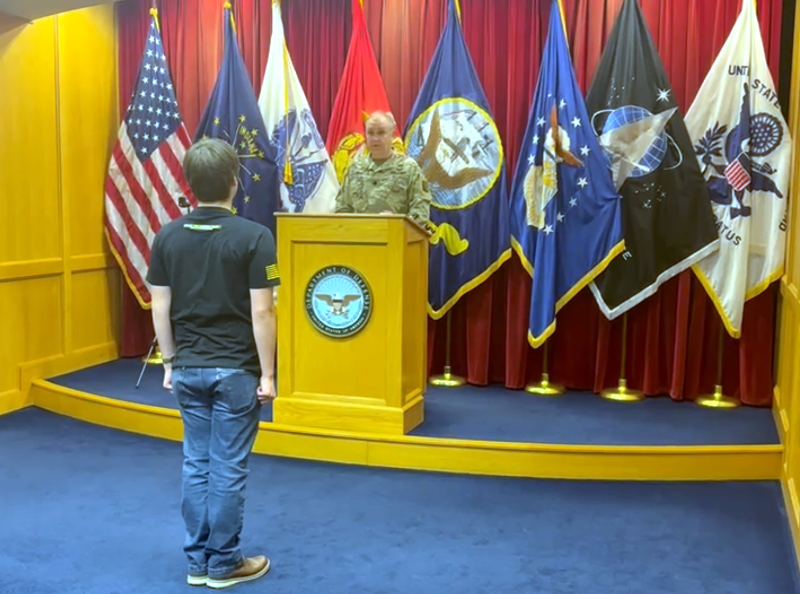
One student who is already taking action and is full steam ahead for service is senior Samuel McElyea. Unlike some students who are waiting till they graduate to jump into action, McElyea officially enlisted into the Army National Guard in September. He already knows where his journey will begin.
“I always had respect for service members and an interest in the military,” McElyea said. “I thought it was cool, so I decided to join.”
McElyea will ship out to Fort Sill, Oklahoma on July 7 before beginning basic training on July 17. After completing basic training, he will travel to Arizona for Advanced Individual Training (AIT).
His Military Occupational Specialty, or MOS, will be 35G, which focuses on geospatial intelligence. In this role he will analyze satellite imagery and terrain to help military leaders understand environments and plan operations.
Before shipping out McElyea is already getting a taste of military training. He drills one weekend each month at the Muncie Armory as part of the National Guard.
“In January I disassembled and reassembled a machine gun and did simulator training,” McElyea said.

Despite the challenges ahead, McElyea believes the military will help him grow into a stronger person. He has also thought about some more concerning matters that come with service.
“I don’t want to go to war,” McElyea said. “But I want to face the challenge. If I quit, I’d question what that says about me.”
Another student who has some big goals in his future is Drayton Swanson. Unlike Patterson, Swanson has some military family background.
Seeing those family members in the military helped shape how he views service and the opportunities that can come with it.
“ I’ve had a few family members that were in service,” Swanson said. “My grandpa retired as a colonel, I think, and my uncle was an officer.”

For Swanson, joining the military is not about following in family footsteps. He also sees the military as a way to build a future outside of service.
One benefit he is particularly interested in is the Veterans Administration home and loan program. This program helps veterans buy a home without needing a down payment.
Swanson first began thinking seriously about joining the military earlier this year.
A conversation with Patterson about enlistment made him start considering the idea more carefully and thinking about how it could help him both now and in the future.
Not only is Swanson focused on serving, he already has long term plans for how he wants to use the opportunities that the military provides to his advantage.
“When I get in the Army, if I get deployed somewhere, I plan on probably living off base,” Swanson said. “I want to try to get a duplex and rent out one side while I live on the other side. Then when I get deployed somewhere else, I’ll rent out both sides.”
Swanson also plans to attend Ball State University through the ROTC program, where most of his education will be paid for while he prepares to become an officer.
He plans to major in construction management which he believes will help him both in the military and in his real estate plans later in life.
Not every student planning a future in the military is interested in combat or engineering roles. For some, the goal is to help people in a different way. For Meriah Koons she hopes to use the military as a way to pursue a career in medicine.
She plans to take this dream to the sky by joining the Air Force working as a flight medic, combining her passion for healthcare with the opportunity to serve others.
“I want to be a medic,” Koons said. “I’ve always loved trauma nursing and all of that.”
After thinking about it for a year or two the possibility of serving while also getting medical experience became more appealing.
“Along with all the benefits that you get, you can also save people and help save lives,” Koons said.

Through military service she hopes to gain skills that will translate into a future career in emergency medicine. One of the most important skills she hopes to develop is the ability to stay calm during pressure situations. Koons also plans to attend Ball State University to earn a nursing degree before entering the Air Force.